Anyone who has taught a class knows that the lesson and the quiz do different jobs. The lesson introduces ideas. The quiz shows you which ideas stuck. Professional training works the same way, and it is a useful lens for people preparing for the Certified GitOps Associate (CGOA) exam from the Linux Foundation and the Cloud Native Computing Foundation.
This article looks at where practice tests belong next to official vendor training, what they can honestly do for you, and what they cannot.

A learner smiling in an office with a certificate graphic, representing the CGOA GitOps Associate practice test course cover
Start with what the exam covers
Before you pick any study material, read what the certifying body says about the exam. The Linux Foundation describes the CGOA as a 90-minute, online, proctored, multiple-choice exam. Its certification page lists five domains with these weights:
- GitOps Terminology: 20%
- GitOps Principles: 30%
- Related Practices: 16%
- GitOps Patterns: 20%
- Tooling: 14%
The same page states that there are no prerequisites and that the certification is valid for two years. The Linux Foundation page does not state the number of questions or the passing score, so treat any figure you see on third-party sites as unconfirmed until you check the official listing yourself.
This breakdown is your map. Principles carries the biggest share, so a candidate who can only recite tool names but cannot explain declarative desired state, versioned and immutable storage, or continuous reconciliation will struggle. Tooling, at 14%, is the smallest slice, which surprises many people who assume a GitOps exam is mostly about one popular controller.
What official training does best
Official courses, documentation and the open GitOps principles are the foundation. They are written by the people who define the terms, so they settle arguments about vocabulary. When you are unsure whether "pull-based" means what you think it means in this context, the primary material is the place to check.
Official training is also where you build understanding that no question bank can replace. Reading how a reconciler compares the declared state in a repository with the state of a running cluster teaches you something a multiple-choice item can only hint at. If you have never touched a Git repository that drives a deployment, spend time in a small test environment first. Hands-on experience makes every later question easier to reason about.
Where practice tests fit
Practice tests come after you have a first pass through the material, not before. Their value is diagnostic and rehearsal based.
They expose gaps you did not know you had. It is easy to feel confident after reading a chapter. A timed set of questions quickly shows whether you can apply a concept when the wording changes. A wrong answer on a pattern question, for example, tells you exactly which section to reopen.
They train your timing. Ninety minutes is generous for some people and tight for others, depending on how carefully you read. Sitting a full-length test teaches you how long you actually spend per item and whether you tend to rush the last stretch.
They teach you how questions are built. Multiple-choice exams reward careful reading. Distractors often differ from the correct option by one word. Practicing with explanations helps you notice those details before exam day.
One way to use them is the Be Ready Education CGOA GitOps Associate practice tests, an independent set of five timed tests with 60 questions each, 300 questions in total, where every question comes with an explanation. These are independent study materials. They are not affiliated with the Linux Foundation, CNCF or any exam provider, and they do not replace the official exam guide or hands-on work.
A simple study plan that respects both
Here is a plan that many busy engineers find workable over a few weeks.
1. Week one, learn the vocabulary. Read the official material on terminology and principles. Write short notes in your own words. Do not take a practice test yet.
2. Week two, patterns and related practices. Study how declarative configuration, version control and automated reconciliation show up in real workflows. Try a small demo if you can.
3. Week three, first practice test. Take one test cold, under timed conditions. Do not look anything up. Afterward, read every explanation, including the ones for questions you got right, because a lucky guess hides a weak spot.
4. Week four, repair and repeat. Map your wrong answers to the five domains. Go back to the official material for the weakest domain, then take another test.
5. Final days, light review. Reread your notes and the explanations for items you missed. Rest before the exam.
The point of the order is simple. Learn first, test second, then return to learning where the test pointed. Taking tests repeatedly without returning to the source material tends to produce memorized answers rather than understanding.
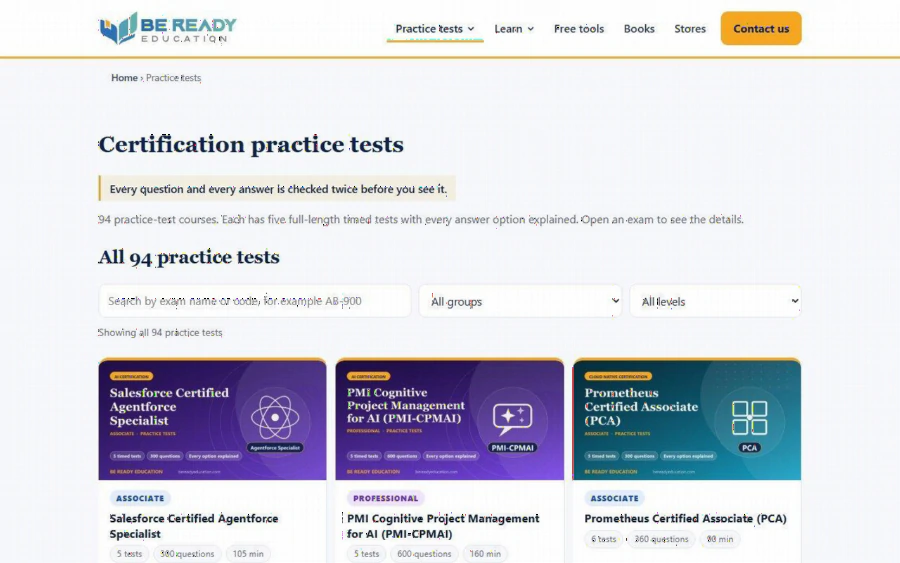
The Be Ready Education certification practice tests page showing a catalog of practice test courses with test counts and durations
Reading explanations like a teacher
The explanation attached to each question is where much of the learning happens. When you review a missed item, try three steps.
First, state in one sentence why the correct option is right. If you cannot, you have not understood it yet. Second, state why each wrong option is wrong. In a GitOps context, wrong options are often true statements about a different practice, such as a push-based pipeline described as if it were reconciliation. Third, link the item to a domain from the official list so you can see patterns in your mistakes.
If you keep a small log of misses by domain, after two or three tests you will see where your effort should go. Many candidates find that terminology questions feel easy until the wording becomes precise.
The limits, stated plainly
It is worth being honest about what practice tests cannot do.
- They do not guarantee a pass. No set of questions can, and the real exam may weight or phrase topics differently.
- They are not a substitute for official training and documentation.
- They cannot give you the judgment that comes from running real systems. If your job includes managing deployments, use that experience as a study asset, and if it does not, build a small lab.
- Question counts and passing marks are set by the certifying body. Check the official page close to your exam date, since details can change.
With those limits in mind, practice tests are a good complement. They turn passive reading into active recall, and they give you a clear picture of your readiness without the pressure of the real session.
Practical tips for exam day
Check your testing environment well before the appointment, since the exam is proctored online. Read each question twice. Flag items you are unsure about and return to them rather than burning time early. Keep an eye on the clock, but do not let it rush you into misreading a question that turns on a single word.
If you do not pass on the first attempt, the Linux Foundation page lists a retake with the exam. Use the result as information. Review the domains where you were weakest and repeat the cycle of learning, testing and repairing.
Final thoughts
Think of your preparation as a classroom with three parts: the textbook, the lab and the quiz. Official training is the textbook, hands-on practice is the lab, and practice tests are the quiz that tells you what to revisit. Used in that order, they help you walk into the exam knowing the material rather than hoping the questions look familiar.
If you want more structured options beyond this one exam, the Be Ready Education practice test catalog lists other certification practice courses built on the same approach.
Tin tức liên quan

Hành trình đi đến chuỗi cửa hàng Clickbuy uy tín toàn quốc
- 27 thg 3, 2024
- 0

DU HỌC NGẮN HẠN - LÊN KẾ HOẠCH CHO MÙA NĂNG ĐỘNG
- 3 thg 5, 2024
- 0

Mơ Thấy Thỏ : Bí Quyết Đánh Số Để Phát Tài
- 5 thg 12, 2024
- 0