Picture a school's STEM coordinator who has just been handed a new job. The district wants to pilot a tool that looks at quiz results in physics and flags students who are likely to struggle with the next unit, so teachers can step in early. Nobody on the team has run an AI project before. The coordinator knows physics teaching inside out, but words like "model evaluation," "precision" and "recall" suddenly appear in every meeting. This article follows that coordinator through one practical question: how do you get ready for a certification in managing AI projects when you are a working educator with very little spare time? The tool we will look at is the PMI Cognitive Project Management for AI (PMI-CPMAI) practice test course from Be Ready Education.
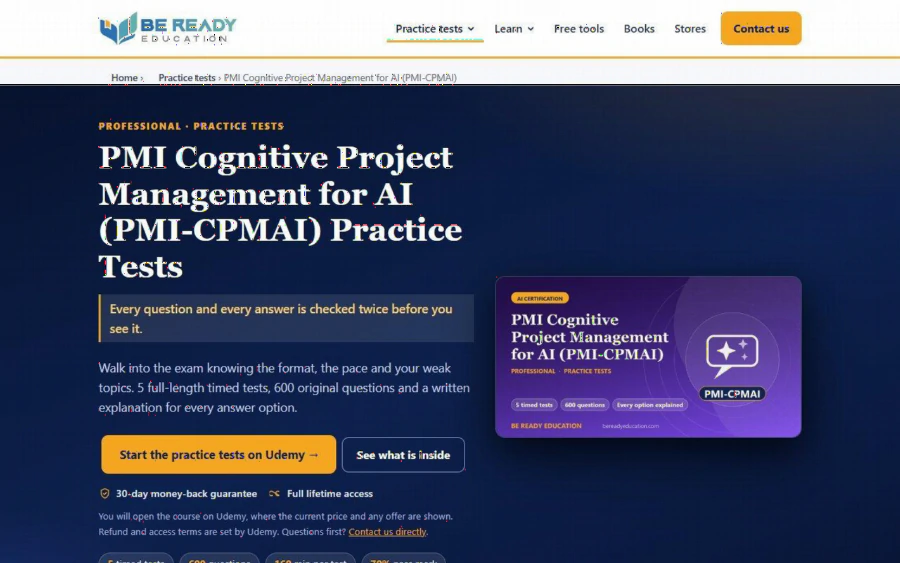
Be Ready Education page for the PMI-CPMAI practice tests, showing 5 timed tests, 600 questions and a 30-day money-back guarantee
Why education teams end up managing AI projects
Schools, colleges and training providers collect a lot of data: attendance, quiz scores, assignment submissions, help requests. Once a vendor or an internal team proposes using that data with machine learning, someone has to own the project. Often that person is not a data scientist. They are a program lead or a delivery manager who understands the people the system will affect.
According to the exam page on the Be Ready Education site, PMI-CPMAI is a professional level certification, and the page lists the people it suits as an AI project manager, or a programme or delivery manager for AI initiatives. That matches our coordinator's situation closely. The page describes the exam as being about managing AI and machine learning projects with the PMI cognitive project management approach. It is a management exam, not a coding exam, and that distinction matters for anyone worried about the technical side.
What the practice tests contain
The facts below come from the course page on the Be Ready Education site, last reviewed on 1 November 2026 according to the page itself.
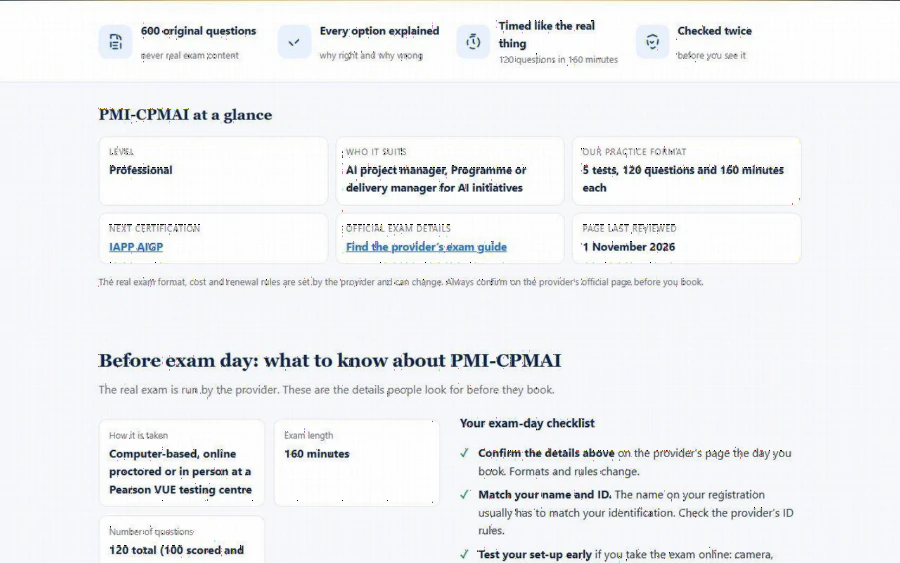
PMI-CPMAI at a glance: 600 original questions, every option explained, 120 questions in 160 minutes
- 5 full-length timed practice tests.
- 120 questions and 160 minutes per test.
- 600 original questions in total.
- A 70% pass mark in the practice tests.
- A written explanation for every answer option, covering why the right option is right and why each wrong one is wrong.
- Every question and answer checked twice before you see it, as the page states.
The page also says the questions are original and are not actual exam content. That is worth stating plainly: this is a way to learn the format, the pace and your weak topics, not a preview of what will appear on the day.
One number is worth writing down. 160 minutes for 120 questions is about 80 seconds per question. If you spend three minutes on a long scenario, you are borrowing time from questions further on. Practicing at this pace is the main benefit of timed tests, because pacing is a skill and it improves with repetition.
A teacher's situation: precision versus recall in a meeting
Here is where the coordinator's pilot becomes a useful study case. The page points out four pairs of ideas that candidates often confuse: data understanding versus data preparation, model evaluation versus model operationalization, precision versus recall, and training data versus test data.
Take precision and recall in the physics pilot. Suppose the tool flags students who may need help. If it is tuned for high recall, it catches most students who really will struggle, but it also flags many who will be fine, and teachers spend time on false alarms. If it is tuned for high precision, almost every flagged student really needs help, but some struggling students are never flagged. Neither choice is simply right. A project manager has to ask which mistake is more costly for this school, and that is exactly the type of judgment a management certification expects you to reason about.
Now the training data versus test data pair. If the pilot team tests the tool on the same quiz results it learned from, the results will look great and mean very little. A manager who has met this idea in a practice question with a full explanation is more likely to ask the right question in the meeting: "Was this evaluated on data the model had not seen?"
I am describing a scenario here, not a result of the course. The page does not claim that the tests teach these exact examples. What it does offer is a structure in which confusable concepts keep coming back across 600 questions, each with an explanation, so you can see the difference more than once.
How to use the five tests
The page also lists a free exam timer, a pass score calculator, a practice score tracker, and 2-week and 4-week study plans. Based only on those pieces, a reasonable routine for a busy educator looks like this.
1. Pick a plan length. Choose the 2-week plan if you have a booking date soon, or the 4-week plan if you can only study in evenings.
2. Take Test 1 as a diagnostic. Do it under the full 160 minutes. Do not pause to look things up. The goal is to find your weak topics, not to score well.
3. Read every explanation, including the ones for questions you got right. The page says every option is explained, and the wrong options are often where the concepts are taught.
4. Log your score. The practice score tracker is there so you can see whether Test 3 is better than Test 1.
5. Repeat weak topics before the next test. If the same confusable pair keeps costing you points, spend a session on that pair alone.
6. Use the last test as a dress rehearsal. Sit it in one block, with a timer, as close to exam conditions as you can manage.
Strengths and limits, stated plainly
The strengths are easy to see on the page. The format is consistent, the volume is large, and the explanation for every option is a real learning aid. The practice course also lists a 30-day money-back guarantee and full lifetime access, though the page notes that refund and access terms are set by Udemy, where the course is hosted.
The limits matter just as much. The page does not give a topic breakdown or weightings for the official exam, and it does not state the official exam fee or passing score. It tells you to confirm these on the provider's official guide. It also does not state the course price, because the current price and any offer appear on Udemy. Practice tests cannot replace studying the official exam content outline, and they do not make up for hands-on experience with a project. If you have never seen a machine learning project from the inside, you will probably want to talk to a data team as well.
The official exam, according to the page, is computer-based, taken online proctored or in person at a Pearson VUE testing centre, with 120 questions in total, of which 100 are scored and 20 are unscored pretest questions, in 160 minutes. Check the provider's page when you book, because formats and rules change.
Who should use this, and who should not
This course suits a program manager, delivery lead or coordinator who is moving toward AI work and wants to practice under time pressure. It also suits a school or training center where one person is preparing to lead a pilot and needs a structured way to learn the vocabulary.
It is less suitable for someone who wants to learn machine learning from scratch. Practice tests assume you will study the material elsewhere and use the tests to check and sharpen. It is also not for anyone looking for a shortcut, because nothing on the page promises a pass.
Getting started
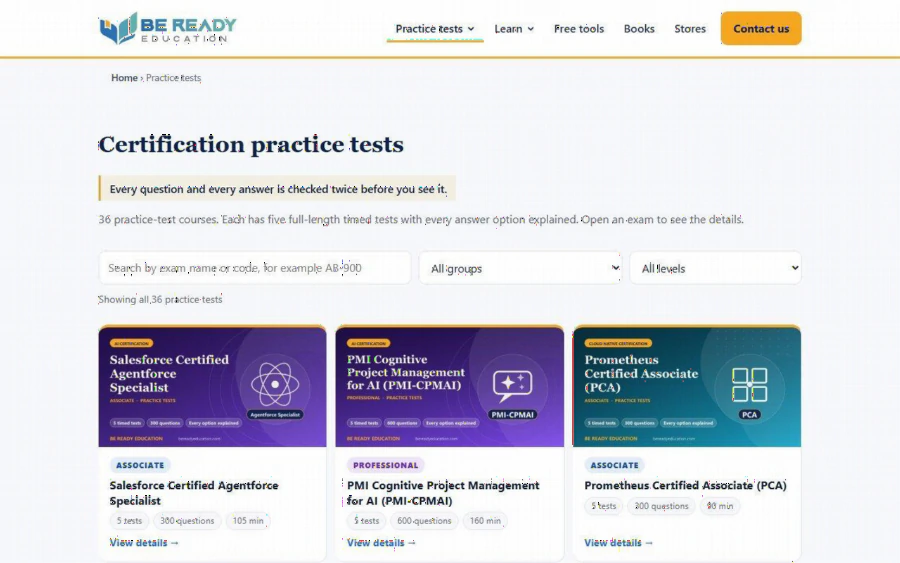
Be Ready Education library of 36 certification practice tests with search and level filters
Start by reading the details on the course page and confirming the official exam information with the provider. Then decide your plan length and take the first test as a diagnostic. If you are curious about other certifications in the same library, the page for all practice tests lists 36 practice-test courses, each with five timed tests and explained answers, and can be searched by exam name or filtered by level.
Back in our physics pilot, the coordinator does not need to become a data scientist. They need to ask better questions about evaluation, about data, and about which mistake the school can live with. Five timed tests, a written explanation for every option, and a clear view of your weak topics are a sensible way to build that habit before the first project meeting.
Tin tức liên quan

Mơ Thấy Thỏ : Bí Quyết Đánh Số Để Phát Tài
- 5 thg 12, 2024
- 0

Hành trình đi đến chuỗi cửa hàng Clickbuy uy tín toàn quốc
- 27 thg 3, 2024
- 0

DU HỌC NGẮN HẠN - LÊN KẾ HOẠCH CHO MÙA NĂNG ĐỘNG
- 3 thg 5, 2024
- 0